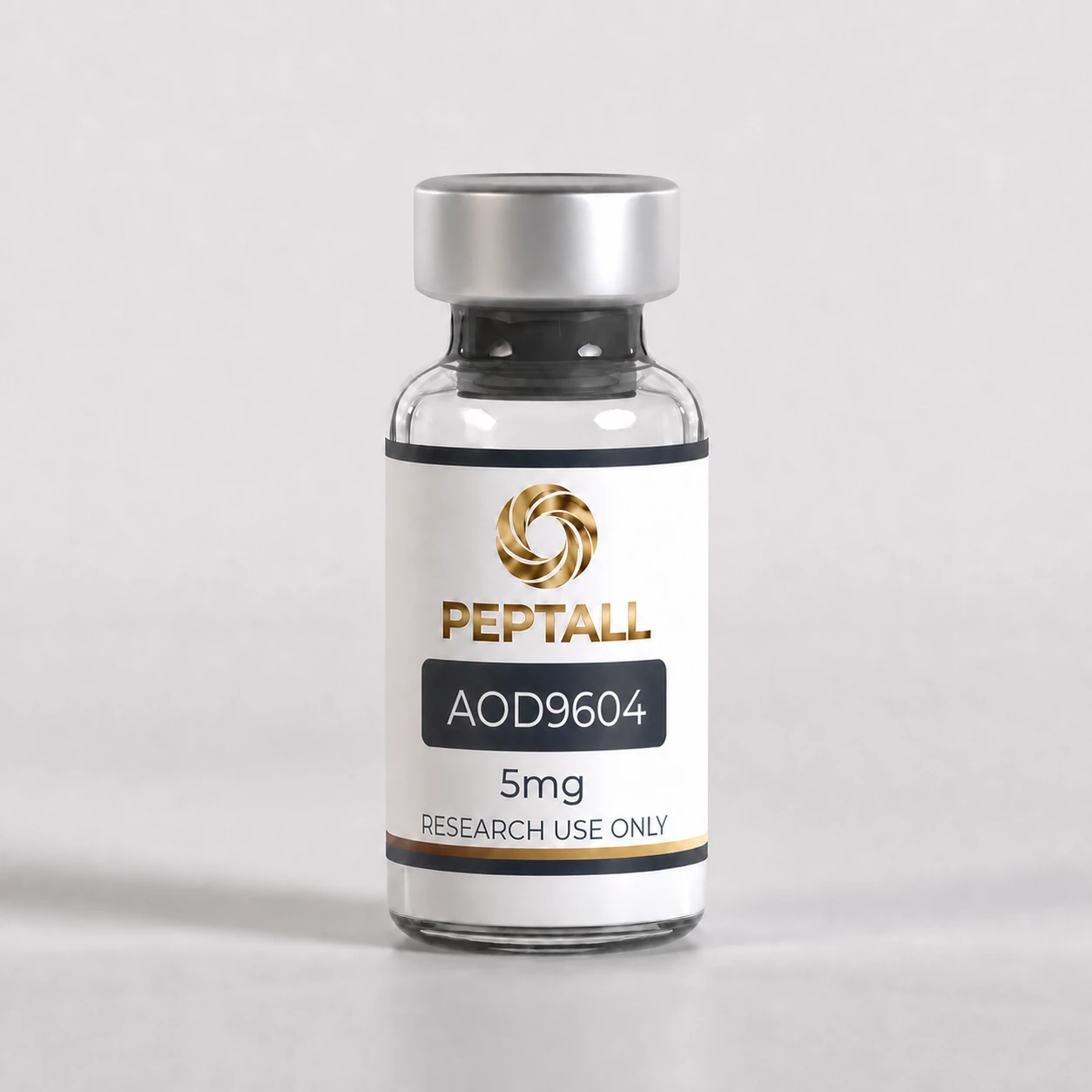
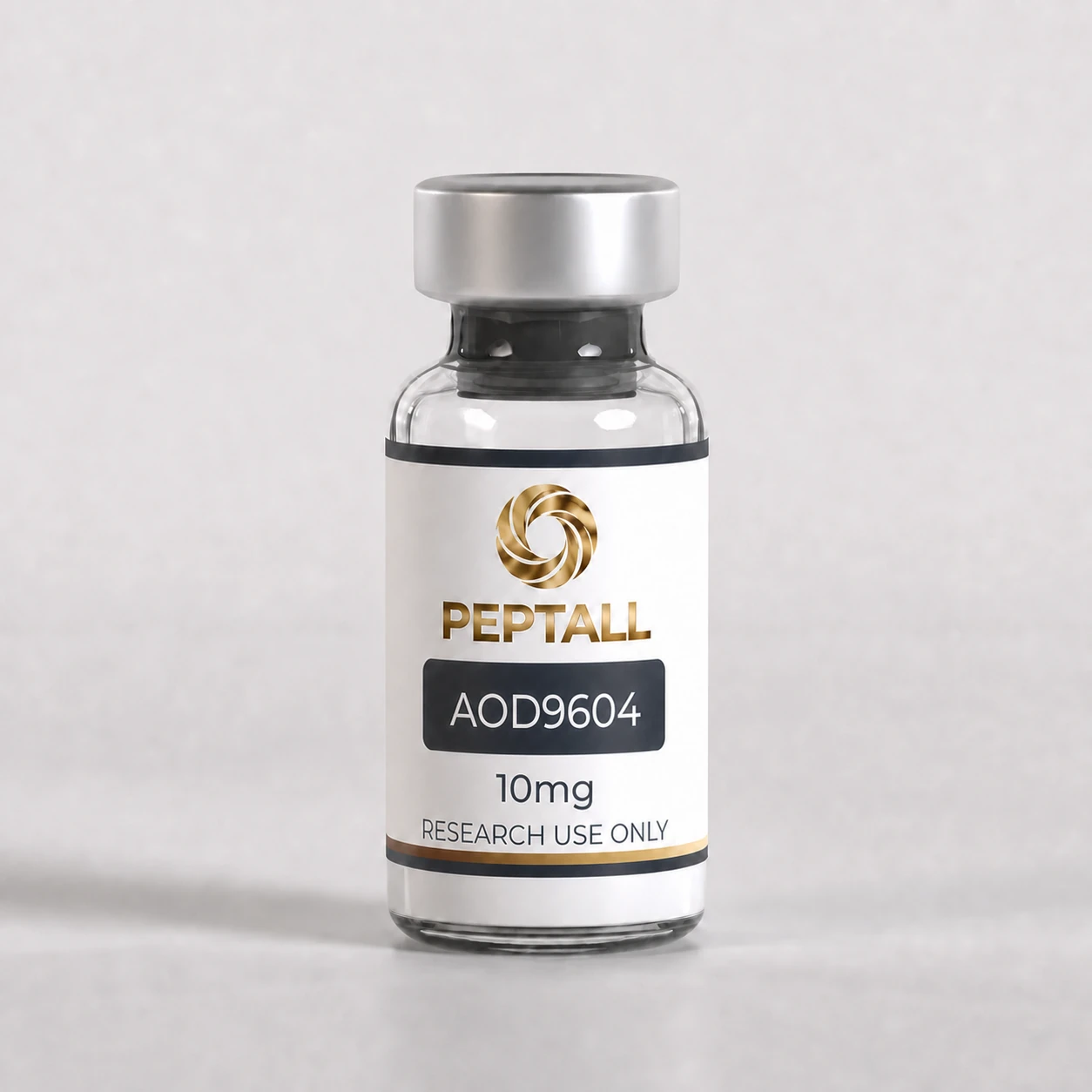
Research Context. AOD9604 is a modified growth hormone fragment based on the 176-191 region used for metabolic pathway research. Findings in experimental models have not established clinical safety or efficacy.
AOD9604 — Technical Research Profile
| Research Classification |
Modified HGH C-terminal Fragment Analogue |
| Available Sizes |
5mg, 10mg |
| Primary Investigation Systems |
Preclinical Lipid Metabolism and Adipocyte Response Models |
Molecular and Structural Context
AOD9604 is derived from the C-terminal 176-191 region of human growth hormone with structural modifications designed to preserve fragment-associated activity without replicating the full HGH molecule.
Mechanistic Research Framework
While studied in metabolic and adipocyte models, its molecular pharmacology must be established experimentally rather than inferred from full-length HGH. Receptor independence, pathway selectivity, and species variations remain relevant areas of study.
Studies commonly evaluate fragment-specific activity, lipid turnover signaling, adipocyte response, and peptide stability.
Experimental Applications and Endpoint Selection
Potential endpoint metrics include lipid accumulation, glycerol release, fatty acid metabolism, adipocyte gene expression, receptor profile screening, and cytotoxicity. Full-length HGH and sequence-matched inactive controls enhance the accuracy of result interpretation.
This material is suitable for analytical, biochemical, receptor pharmacology, cellular, or other controlled preclinical workflows, depending on the target system. Study design should define biological matrix, exposure duration, concentration ranges, replicate structures, acceptance criteria, and statistical protocols prior to data collection.
Key Areas of Scientific Investigation
- Fragment-specific metabolic signaling
- Lipid turnover and adipocyte models
- Comparative peptide stability
Technical Keywords
- Modified HGH fragment
- Adipocyte research
- Lipid handling
- Mechanistic validation
Analytical Characterization Considerations
The exact sequence, conformation, terminal modifications, and purity profile should be verified, as related HGH fragments may not be interchangeable. Liquid Chromatography–Mass Spectrometry (LC-MS) and Reverse-Phase High-Performance Liquid Chromatography (RP-HPLC) can be utilized for identification, while cell-based metabolic assays help validate functional hypotheses.
Where scientifically appropriate, laboratories may employ orthogonal methods such as RP-HPLC for chromatographic purity, LC-MS for molecular identity, size-sensitive methods for aggregation, and target-relevant functional bioassays. Method suitability, reference standards, system suitability, and acceptance limits must be independently established; these examples do not constitute batch-specific analytical claims.
Study Design and Interpretation
Use vehicle controls, positive controls, negative controls, and concentration-matched controls aligned with assay methods. Receptor expression, biological matrix, incubation time, adsorption, proteolysis, passage number, and species background can all influence apparent potency or pathway outputs. In vitro or animal model findings should not be extrapolated to human applications.
Handling and Documentation
Use calibrated equipment and document receipt, storage, preparation, aliquoting, freeze-thaw cycles, and disposal procedures. Solvent compatibility, working concentrations, stability windows, container adsorption, and analytical recovery must be established by the purchasing laboratory based on applicable batch documentation and institutional SOPs.
Important Compliance and Safety Notice
- This product possesses no therapeutic, diagnostic, cosmetic, or veterinary efficacy.
- Work must be conducted by qualified personnel in accordance with applicable institutional and regulatory requirements.
- Use appropriate personal protective equipment (PPE) and follow controlled laboratory protocols.
FOR RESEARCH USE ONLY. NOT FOR HUMAN OR ANIMAL CONSUMPTION.
Research Use Statement: This material is intended solely for legitimate research and analytical use. Researchers are independently responsible for determining material suitability, laboratory safety, and compliance with all applicable requirements.