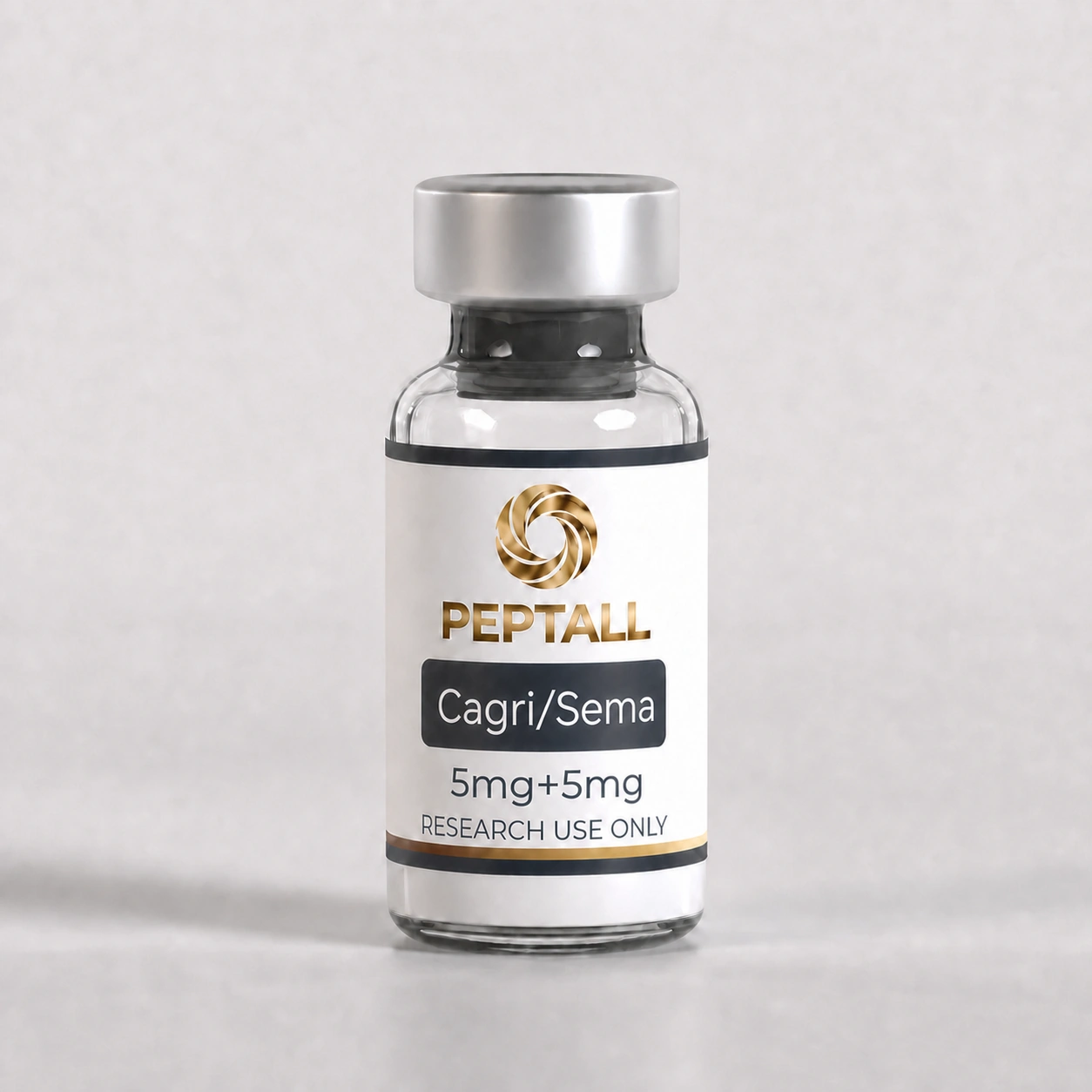
Research context. Cagrilintide/Semaglutide (CagriSema) is a co-formulated or dual-peptide research system combining a long-acting amylin analogue with a glucagon-like peptide-1 (GLP-1) receptor agonist. It is supplied as a research material for experimental investigations into dual metabolic receptor co-activation, appetite regulation pathways, and metabolic homeostasis. Findings from experimental models do not establish clinical safety or efficacy.
Cagri / Sema — Technical Research Profile
| Research classification |
Dual Amylin receptor & GLP-1 receptor co-agonist complex |
| Available size(s) |
5MG+5MG |
| Primary research system |
Amylin receptors (AMYR1, AMYR2, AMYR3) and GLP-1 receptor (GLP-1R); cAMP intracellular cascade & central satiety networks |
Molecular and structural context
Cagrilintide is a non-acylated/acylated analogue of human amylin engineered with fatty acid side chains for extended half-life, while Semaglutide is a modified GLP-1 analogue possessing high albumin affinity via C18 fatty diacid conjugation. The combination represents a dual-mechanism system designed to evaluate synergistic signaling via distinct receptor targets involved in energy balance.
Mechanistic research framework
The co-presence of Cagrilintide and Semaglutide engages both Amylin and GLP-1 receptors simultaneously. Activation of AMYRs modulates central hindbrain area postrema pathways associated with satiation, while GLP-1R engagement regulates hypothalamic neurocircuitry and insulin/glucagon dynamics.
In vitro and in vivo models commonly evaluate dual-pathway cAMP accumulation, delayed gastric emptying kinetics, glucose-dependent insulin secretion, adiposity modulation, and metabolic rate adaptation under co-treatment protocols.
Experimental applications and endpoint selection
Research protocols frequently analyze the potential additive or synergistic actions of dual receptor agonism on food intake suppression, lipolysis enhancement, glycemic control, and metabolic energy expenditure. Experiments should distinguish individual AMYR/GLP-1R signaling outputs from combined co-agonist phenotypes.
This material is designed for biochemical, receptor-binding, cellular signal-transduction, and rodent metabolic workflows. Study designs must clearly establish dosing schedules, exposure windows, vehicle parameters, and quantitative biological endpoints prior to testing.
Principal areas of scientific inquiry
- Dual-receptor crosstalk (AMYR & GLP-1R)
- Central and peripheral satiety network regulation
- Synergistic metabolic and body composition models
- Incretin and pancreatic hormone receptor kinetics
Technical keywords
- Amylin agonist
- GLP-1 receptor co-activation
- Dual peptide synergy
- cAMP signaling
- Energy balance dynamics
Analytical characterization considerations
Peptide solubility, secondary aggregation, peptide-to-peptide physical stability, and hydrophobic interactions require careful optimization when co-formulating dual peptides. High-performance liquid chromatography (HPLC), liquid chromatography-mass spectrometry (LC-MS), and cell-based bioassays are recommended to assess individual component purity and stability.
Laboratories should utilize orthogonal analytical techniques, such as RP-HPLC for chemical purity, LC-MS for structural confirmation, and receptor-specific reporter cell lines to verify target activation. Method suitability and acceptance limits must be independently validated for each research batch.
Study design and interpretation
Experimental controls should include vehicle-only, single-agent (Cagrilintide alone and Semaglutide alone), and dose-matched combination groups. Differences in receptor expression density, biological matrix compositions, cell line passage numbers, and animal species can significantly impact signaling outputs and apparent potency. Results obtained in vitro or in animal models cannot be extrapolated to human physiology.
Handling and documentation
Reconstitution should be executed under sterile laboratory conditions using verified diluents. Avoid repeated freeze-thaw cycles and high-shear agitation, as these may lead to peptide degradation or aggregation. Maintain detailed laboratory records regarding reconstitution dates, storage conditions, and lot numbers.
Important compliance and safety remarks
- No therapeutic, diagnostic, cosmetic, or veterinary claims are made.
- Work must be performed by qualified scientific personnel under applicable institutional and laboratory safety standards.
- Use appropriate personal protective equipment and controlled containment procedures.
For research use only. Not for human or animal consumption.
Research-use notice. This material is supplied solely for legitimate research and analytical purposes. Researchers are responsible for material suitability, laboratory safety, and compliance with all applicable legal and regulatory requirements.